Creating a Classic
A review of Sammy Harkham’s Blood of the Virgin

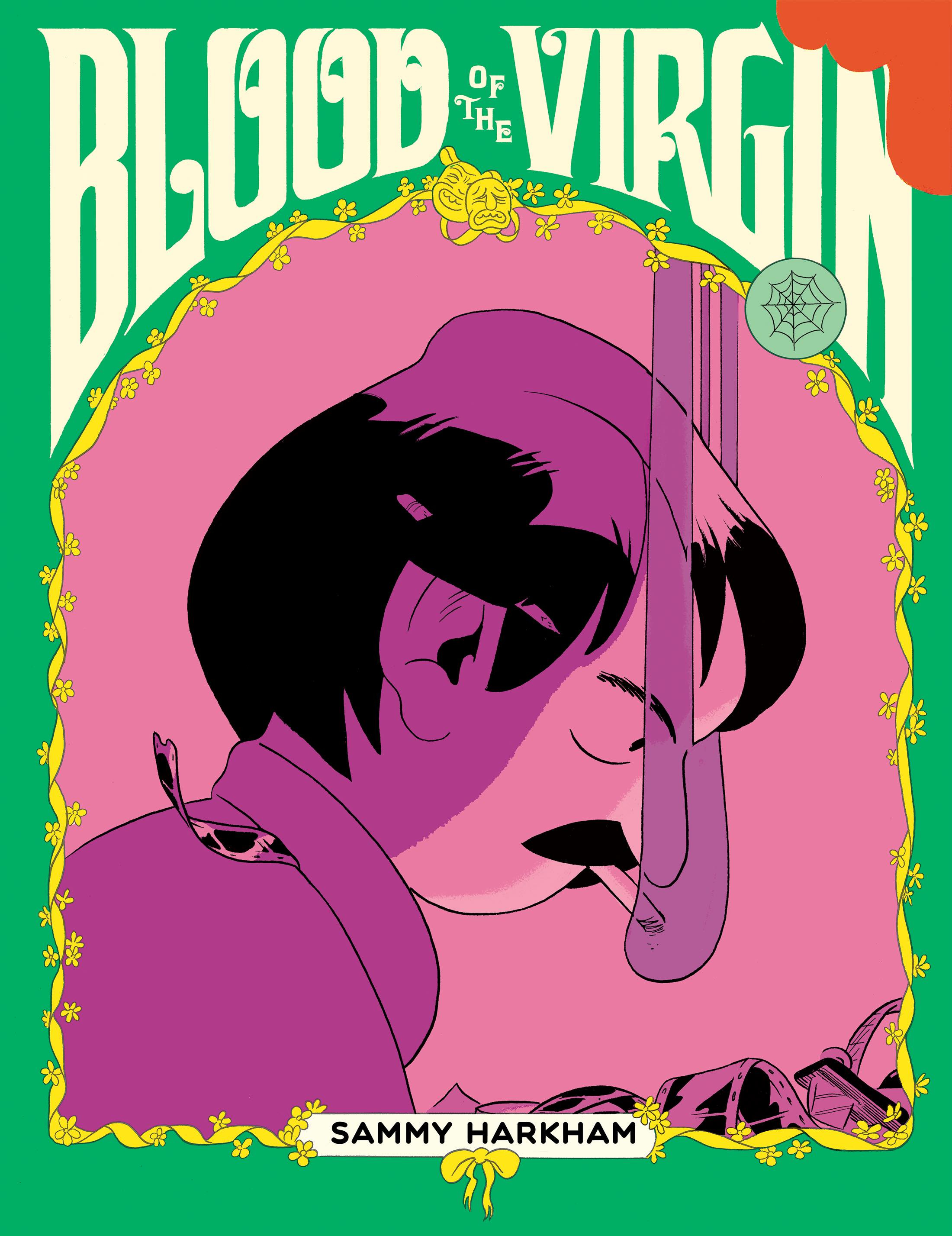
Sammy Harkham’s graphic novel Blood of the Virgin shares a lot of similarities, whether by design or by accident, with its subject material, particularly Hollywood and B-movies, through its creation, narrative, and reception. The graphic novel, like so many cinematic labors of love, took years to complete. Similar to an Arrow Video release, there are loose ends, and by the conclusion, you fall in love with the atmosphere the work creates. Harkham re-creates the B-movie experience in graphic novel form, and it is a shame that it was released in 2023, the same year as Daniel Clowe’s Monica.1 As my friend who used to work at a comic bookstore said, there can only be one graphic novel a year that the general public will read, and that year it was not Blood of the Virgin.
The idea that there can only be one graphic novel a year is not a judgement one way or another on the book itself, and I have no data into its sales. However, the comment does bring up a significant aspect of the movies Harkham’s work loves so much: No matter what the creator feels about their medium, it is impossible to predict how that film will be received or even produced. This seems obvious, but in today’s world where art can feel infinitely editable and is controlled by a few conglomerates, Blood of the Virgin harkens back to a past that should not be missed—but rather envied. Even if Blood of the Virgin was overwhelmed by another graphic novel’s release, Harkham created a book that will last into the future, act as a window into the past, and find its home among those looking for something available as more than background noise.
Blood of the Virgin takes place in 1970s Los Angeles, following the lives of Seymour and his wife, Ida. Seymour works as an editor at the B-movie studio Reverie Films; Ida wastes away, bored at home with a toddler. Hollywood has gone through many lives, and there is the possibility for young upstarts to enter the scene and make it onto the silver screen. Seymour, with his Sephardic background, feels out of place, both with his own family who work at auto body shops and hate his Ashkenazi wife and with his co-workers who can never figure out where he’s from. He is too late, as one character tells him, to be another Louis B. Mayer, the “milkman who came west from Stubenville,” and he is not there for the climate.2 But the movies are the one place we see him at home. One day, Seymour’s boss says his script, Blood of the Virgin, will get made. When the original director fights with one of the leads and wastes time filming bugs, Seymour gets his big break and is assigned to direct and finish the film. There are scenes on set that show in detail the trials and tribulations of how hard it is to make even the smallest budget films. It is a world of schmucks, with Seymour being the utmost one, though as a Sephardim he would say I am an uptight Ashkenazi prick.
We never understand what the movie is about; supposedly, it is a werewolf picture but after that the details are murky. More importantly for Seymour, it is a communique with the past. When the lead actress, Joy, asks for notes on a scene, Seymour responds, “When I wrote this scene, I was thinking of Raymond Massey’s presence.” He later tells her, “These pictures may not get you a table at Chasen’s, but they are the only movies that matter.” When he and Ida have a movie night in, they watch one shlocky film after another and Ida turns the lights on to see Seymour crying.
We create art to express ourselves but also to become part of a lineage and of tradition. Yet, being a node in a larger artistic practice is no guarantee that you will succeed personally or professionally. Seymour’s marriage falls apart as Ida runs off to New Zealand with their baby, and all of his references and love for genre movies fall on deaf ears. Joy does take the table at Chasen’s, and we hear two of the PAs discuss how horror is not really their thing. Before he realizes his time is up as director, Seymour’s reels are stolen and he cannot finish editing the film. He is not invited to his own wrap party, and he is subjected to slapstick violence due to his obsession. Before he goes on a bender, he tries to watch a movie at a grindhouse theater, only to be disrupted by a couple passionately making out. Even the audience is not there for movie magic.
Grindhouse cinema might not make it out of the ’70s, but we should not discount how movies are, as film director David Cronenberg describes them, “a cemetery”—which is to say, we may never know what we might return to in the future. In Blood of the Virgin, there is a chapter that cuts back 60 years to the story of actor Joe Clayton and his success in early Hollywood. We learn about his relationship with Bertram Cole, a studio executive who takes Joe under his wing and ends up screwing him over. It is a classic Hollywood tale, but at the end of Joe’s story we see him alone and bitter in his Spanish Colonial style home. He tells a visitor he is happy that he outlived Bertram Cole and was at his funeral only out of spite.
When we return to Seymour and Ida at the end they are reunited in Los Angeles, exploring Joe Clayton’s abandoned home. They probably know that Joe used to live there and seem at peace sifting through the rundown past. We do not know if they intend to buy the house, but to stand with the ghosts of an even older Hollywood is a privilege they both relish.
Today, when so much of what fills our theaters feels produced within an inch of its life to fulfill a specific objective, Blood of the Virgin harkens back to a not-so-distant past where, despite everything, what appeared on our screens and in our hands came to be there a little bit more organically. A movie could be made in weeks and enter a distribution network where it could make a profit. In a twist, the graphic novel concludes with the head of Reverie Films, Val Henry, trying to hand over a check and Seymour refusing it due to the movie being a surprise hit. To Seymour, the payday is not enough to overcome the offense of Reverie Films taking away his control, but he should recognize that it was, in part, his tireless efforts to make a unique horror film that made it a hit. It feels like this now rarely happens. Everything is controlled tip-to-tail, and everyone wants to make a cult classic instead of letting it happen by happenstance. The entertainment industry (whether it be film, TV, or publishing) has been moneyballed, but the story of how Sammy Harkham wrote this graphic novel is a testament to taking risks in creative tasks. In the end, it doesn’t matter if Blood of the Virgin was overshadowed. What matters is that it is here, waiting for everyone else to catch up.
This not to compare and contrast the two, they have nothing in common (outside of being in the same section) and I consider them both masterpieces. We should count our lucky stars to get two stellar graphic novels in one year.
As he tells one of his co-workers, he hates the desert, which reminds me of Joe Pesci’s line in Casino, “I mean, what do you think we're doing out here in the middle of the desert?”